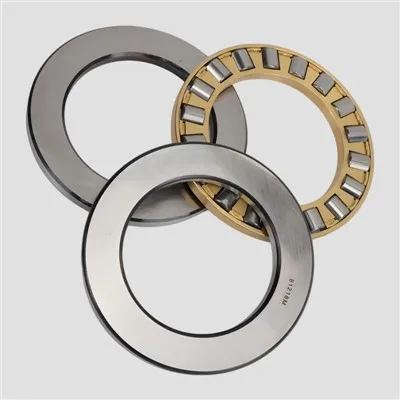
If you’ve ever worked with rotating industrial machinery—whether it’s a wind turbine, a mining conveyor, or a heavy-duty pump—you know that the quiet workhorse keeping axial loads from grinding components to a halt is the thrust roller bearing. As a bearing supplier who’s spent 12 years troubleshooting with plant managers and maintenance teams across North America, I’ve seen first-hand how choosing the wrong lubricant for a thrust roller bearing can turn a scheduled 10-minute lubrication top-up into a 48-hour unplanned shutdown. Last year alone, a midwest grain processor called us in after their #5 bucket elevator thrust bearing failed; they’d used a standard multi-purpose grease meant for radial ball bearings, and within three months, the roller ends were pitted, the raceways cracked, and they lost $120,000 in product and downtime. That’s why today, I’m breaking down exactly what types of lubricants work for thrust roller bearings, what makes them different from lubricants for other bearings, and how you can pick the right one for your application. Thrust Roller Bearing

First, let’s get one critical distinction out of the way: thrust roller bearings aren’t the same as their radial counterparts. Radial bearings handle loads perpendicular to the shaft, but thrust roller bearings carry loads parallel to the shaft—often extremely heavy ones. Think of a crane lifting a 50-ton load, or a wind turbine’s main shaft pushing against its housing during high winds. That axial load means the lubricant has to do more than just reduce friction; it has to separate the tapered or cylindrical rollers from the raceways, seal out contaminants like dust or water, and withstand extreme pressures that would shear a regular lubricant apart. That’s why “one size fits all” lubrication doesn’t work here.
Let’s start with the most common lubricant for thrust roller bearings: grease. For 70% of the applications we service, grease is the go-to, and for good reason. Thrust roller bearings operate with relatively low-speed, high-load conditions in many industrial settings, and grease acts as both a lubricant and a temporary seal—no need for complex centralized lubrication systems. But not all greases are created equal. When it comes to thrust bearings, you want a grease with a base oil viscosity that’s higher than what you’d use for radial bearings. For most standard thrust roller bearings (like our 8100 series, used in conveyor systems), we recommend a base oil viscosity of 220 to 460 cSt at 40°C. That thickness holds up under the high contact pressure between rollers and raceways—thrust bearings have contact pressures up to 4,000 psi, compared to 1,500 psi for most radial bearings—so a thinner grease would squeeze out between the surfaces, leading to metal-on-metal wear.
Also, pay attention to the thickener. Lithium complex greases are a safe, reliable bet for general-purpose thrust roller bearings. They have good water resistance, work in temperatures from -20°C to 120°C, and have a consistent structure that doesn’t break down under repeated loading. But if you’re working in extreme conditions—say, a steel mill where temperatures regularly hit 150°C, or a coastal port where saltwater is a constant risk—you’ll need something stronger. Polyurea greases are better for high-temperature applications; they resist oxidation far longer than lithium complex, so they won’t turn brittle and harden even after years of service. For saltwater or high-humidity environments, aluminum complex greases have superior water repellency, forming a barrier that keeps moisture out of the bearing’s internal components. One note here: avoid soap-based greases for heavy thrust loads. Simple lithium greases (not complex) lack the structural stability to maintain a lubricant film under axial load, leading to early wear.
Next up: oil lubrication. While grease is common, oil is the better choice for high-speed thrust roller bearing applications. If you’re dealing with a thrust bearing on a turbine or a centrifugal pump that runs at 10,000 RPM or higher, grease can’t handle the centrifugal force— it will sling out of the bearing, leaving it unprotected. Oil, on the other hand, circulates through the bearing, carries away heat, and maintains a consistent lubricant film even at high speeds. For high-speed thrust roller bearings, we recommend a mineral oil with a viscosity of 68 to 150 cSt at 40°C, paired with an anti-wear (AW) additive package. Wait—anti-wear isn’t just for gear oils. Thrust bearings rely on that additive to prevent metal-to-metal contact when the load spikes, even if the oil film is slightly thin. For even more demanding high-speed applications, like gas turbine thrust bearings, synthetic oils are worth the investment. Polyalphaolefin (PAO) synthetic oils have a wider temperature range (-40°C to 180°C) and better oxidation resistance than mineral oil, so they last longer and reduce the need for frequent oil changes. I recently worked with a wind farm operator who switched from mineral oil to PAO in their turbine thrust bearings; they went from changing oil every 6 months to every 3 years, cutting their maintenance costs by 70% per bearing.
There’s a third type of lubricant that’s gaining traction in heavy-duty applications, especially for very large thrust roller bearings used in mining or marine equipment: solid lubricants. When you have a bearing that operates in extreme temperatures (above 200°C, where oils and greases carbonize) or in environments where there’s no way to seal out contaminants, solid lubricants are the answer. The most common ones for thrust bearings are molybdenum disulfide (MoS₂) and graphite. MoS₂ is a dry lubricant that forms a thin, slippery film on the roller and raceway surfaces, perfect for high-load, low-speed applications like mine shovels. Graphite is better for high-temperature environments, like cement kiln thrust bearings, where it can withstand heat that would destroy grease. That said, solid lubricants aren’t a standalone solution. They work best as a supplement to grease or oil—you don’t want to use MoS₂ alone, because it can’t dissipate heat or prevent corrosion. We usually recommend applying a small amount of MoS₂ mixed with a lithium complex grease as a top-up for mine equipment that runs 24/7.
Now, let’s talk about what to avoid, because I’ve seen too many teams make these mistakes. First, don’t use multi-purpose grease rated for radial bearings. I mentioned that earlier, but it’s worth repeating. A standard multi-purpose grease has a base oil viscosity of 100 to 150 cSt, which is too thin for thrust loads. It will squeeze out of the contact area, leading to scuffing and pitting. Second, don’t over-lubricate. It’s a common myth that more grease is better, but for thrust roller bearings, too much grease causes churning. When the bearings spin, excess grease heats up, breaks down, and can cause seal damage. The general rule for grease-lubricated thrust bearings is to fill 30% to 40% of the bearing’s internal cavity. For oil-lubricated systems, keep the oil level at the center of the lowest roller—any higher and you’ll get excessive churning, any lower and you risk the pump or circulating system drawing in air. Third, don’t mix lubricant types. If you’ve been using lithium complex grease, switching to polyurea grease without flushing the bearing will cause the thickeners to react, break down the lubricant, and form a sludge that clogs the bearing. It’s a messy, expensive mistake I watched a paper mill make two years ago—they mixed greases, and their paper machine’s thrust bearing failed 2 weeks later, costing $200,000 in lost production.
Finally, how do you choose the right one for your specific thrust roller bearing? Let’s break it down by application:
- Standard industrial conveyor, crane hook, or pump (low speed, moderate to high load): Lithium complex grease, NLGI grade 2, with base oil viscosity 220 cSt. This works for 80% of general applications.
- High-temperature steel mill or foundry (temperatures 120°C to 150°C): Polyurea grease, NLGI grade 2, with extreme pressure (EP) additives. EP additives are critical here—they bond to the metal surfaces to prevent wear under high heat and load.
- Coastal or marine equipment (high humidity, saltwater exposure): Aluminum complex grease, NLGI grade 2, with corrosion inhibitors. This will repel moisture far better than lithium complex.
- High-speed turbine or centrifugal pump (above 5,000 RPM): PAO synthetic oil, viscosity 100 cSt, with anti-wear and oxidation inhibitors. For speeds above 10,000 RPM, consider a ester-based synthetic oil for even better heat resistance.
- Heavy-duty mining equipment or kilns (low speed, extremely high load, extreme temperatures): Molybdenum disulfide mixed with lithium complex grease, or a solid lubricant coating if the bearing is designed for dry lubrication.
If you’re still not sure which lubricant is right for your thrust roller bearing, don’t guess. I’ve helped hundreds of maintenance teams audit their equipment and pick the right lubrication schedule, and I’d be happy to walk through your specific application, share data from our in-house testing with thrust bearings, and help you avoid costly downtime. Every application is different—what works for a wind turbine won’t work for a mine shovel, and vice versa. Let’s connect to talk through your needs, so your thrust roller bearings can run longer, more reliably, and without the kind of failures that derail operations.
Ball Bearing References:
Shah, S. (2021). Lubrication of Rolling Element Bearings: Selection, Application, and Maintenance. CRC Press.
American Bearing Manufacturers Association (ABMA) Standard 13-2018: Lubrication of Rolling Contact Bearings.
NLGI (National Lubricating Grease Institute) Publication No. 10: Grease Selection for Rolling Element Bearings.
ISO Standard 12049: Rolling Bearings – Thrust Bearings – Boundary Dimensions and Tolerances.
Yantai Wared Bearing Co., Ltd.
As one of the most professional thrust roller bearing manufacturers and suppliers in China, we also support customized service. Please feel free to wholesale durable thrust roller bearing made in China here and get pricelist from our factory. For price consultation, contact us.
Address: North Street, Donglai Subdistrict, Longkou, Yantai, Shandong Province, China
E-mail: postmaster@bearingzwz.com
WebSite: https://www.bearingzwz.com/
